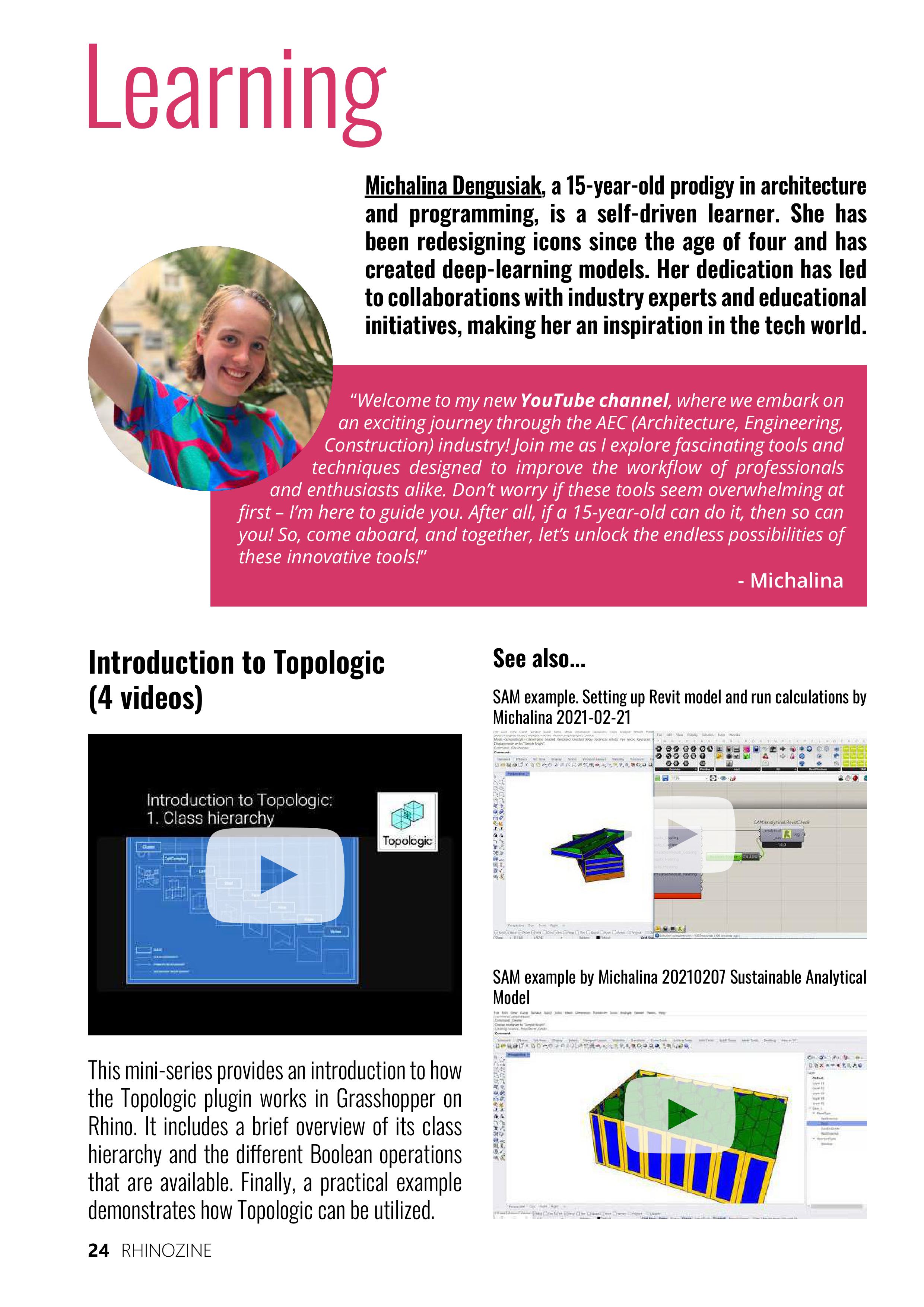
I'm Michalina Dengusiak, a first-year Computer Science student at ETH Zürich. Although, I am just embarking on my professional journey, I already had the possibility of accomplishing quite a sum of things... Click here to see my resume!
My father, a computational engineer, often browsed the Grasshopper Forum in the evening. One night, as I sat beside him watching his screen intently, something caught my eye - the Honeybee plugin icon. Without a second thought, I blurted out, "Bees aren't yellow!" Having spent countless summers at a family friend's apiary, I had learned the key difference between wasps and honeybees — wasps are yellow, whereas honeybees are more of an orange hue. Therefore, my father reached out to Mostapha, the creator of the plugin. Together, we worked on adjusting the color scheme to better reflect the true shade of honeybees. From that day onwards, not only was I pleased with the new icon, but I also had new stickers on my computer to celebrate this success.
When I was 5 years old, an architect held a workshop at my kindergarten where we created our own cardboard houses. Afterwards, when I got home, my father saw my creation and asked if I wanted to see how different animals around the world would feel in my house. At first, I didn’t fully understand what he meant, but I agreed anyway. He introduced me to Ladybug Tools in Grasshopper (Rhino) and used it to explain the movement of the sun throughout the day and year. Together, we conducted a sun path analysis on my cardboard house prototype in various climate regions.
At the beginning of 7th grade, I was surprised and excited to be invited to PARAMETRIA, a course focused on parametric design, digital manufacturing, and product development. Each week, a different instructor would guide participants through a unique project, taking them from the modeling phase in Grasshopper (inside Rhino) all the way to actual physical manufacturing. I took part in the week led by Mateusz Zwierzycki, where the project was to create a parametric façade, that could adjust its orientation throughout the day and year. The goal was to design a system that, in summer, would block sunlight to prevent the building from overheating, and in winter, would allow sunlight to pass in order to help warm it up.We started by brainstorming and prototyping ideas to solve this challenge. Next, we programmed the concept in Grasshopper, and to improve the code’s efficiency, we translated the logic into C#. In the final step, we manufactured the façade by laser-cutting cardboard panels and building a wooden frame. This was the first time I truly witnessed the full process of how an idea develops into a physical product and it completely changed the way I thought about computer programming. It showed me its real-world power. Furthermore, it made me determined to learn more about Rhino, Grasshopper, and even C#, so that one day I could handle projects like this on my own.
In 7th grade, I was lucky to get an internship at McNeel Europe. Before starting, I assumed I’d be stuck with simple tasks (my teacher even warned me I might just end up fetching coffee!), but I was pleasantly surprised: I spent the entire week programming, 3D printing, and learning new things. The team was incredibly supportive, always happy to answer my questions and going out of their way to make me feel welcome. During the internship, I worked on two main projects. The first was creating a 3D-printed model of the Chernobyl power plant. To achieve the final physical object, I first sourced the original blueprint and used the measurements to model it in Grasshopper. At the end, I also implemented Topologic to ensure the model was watertight and ready for printing. Since I still had time left, I began developing a program to snap any 2D geometry to a grid using Python inside Grasshopper. This wasn’t an easy task, as new challenges kept popping up along the way. Overall, this experience gave me firsthand insight into what it’s like to work as a programmer in a software development company — and it left me with one clear thought: I want to work like this someday
In 9th grade, I had the opportunity to intern at Micropsi Industries, a company that focuses on training robots to perform highly specialised tasks using AI. During my two-week intership, I was given the task of training a deep learning model to recognize whether a specific object is facing upwards or downwards - a task that, as it turns out, was a real project the company was working on! To tackle this, I began by following a tutorial on a similar image classification task: differentiating between cats and dogs using transfer learning (specifically fine-tuning pre-trained models like MobileNetV2). This gave me a good understanding of the model training process and introduced me to techniques like data augmentation, that transforms images to increase the dataset, without collecting more images. I also learned about setting the optimal number of epochs (the number of times the model is trained on the same dataset), to avoid overfitting or underfitting, which is necessary to achieve high accuracy. Once the model worked on static images, the next challenge was to adapt it to a real-time video input. Therefore, I wrote a script to extract the image frames from a video, and pass them to the model. This made it possible, for the model to classify the object's orientation, so that connecting it to a camera worked! At the end, as a fun bonus, we even hooked the model up to an actual robot, and to my amazement it classified the orientation of the object flawlessly! The internship was a great experience, and I learned so much about the field of AI and robotics, that I could definitely see myself working here in the near future!
“Michalina is a hardworking student with high potential. She quickly owned the task like a professional engineer.”
Attending and presenting at the BILT Europe conference in Valencia was an unforgettable experience. After years of delays due to COVID, our presentation finally came to life. It was my first time presenting to such a specialized and knowledgeable audience. At first, I was nervous and hesitant to engage with the experts around me, feeling like I couldn’t match their depth of knowledge — but I was met with incredible openness and encouragement. Despite that, I was still anxious before my presentation, which was scheduled for the second day. But once I began, the nerves faded, and all the preparation I had done kicked in. Our session focused on building watertight models efficiently using two Grasshopper plugins: Topologic and SAM. Since SAM is the product of my father’s work, I focused on Topologic — researching everything I could find and even reaching out to its founders, Prof. Aish and Prof. Jabi, who generously supported me and answered all my (many) questions. During this process, I realized how helpful it would be to have a step-by-step guide to the plugin, so I launched the Topologic Mini-Series — a beginner-friendly video series designed to share what I’ve learned and help others get started with Topologic. Feel free to check it out — I’d love to hear your feedback!